
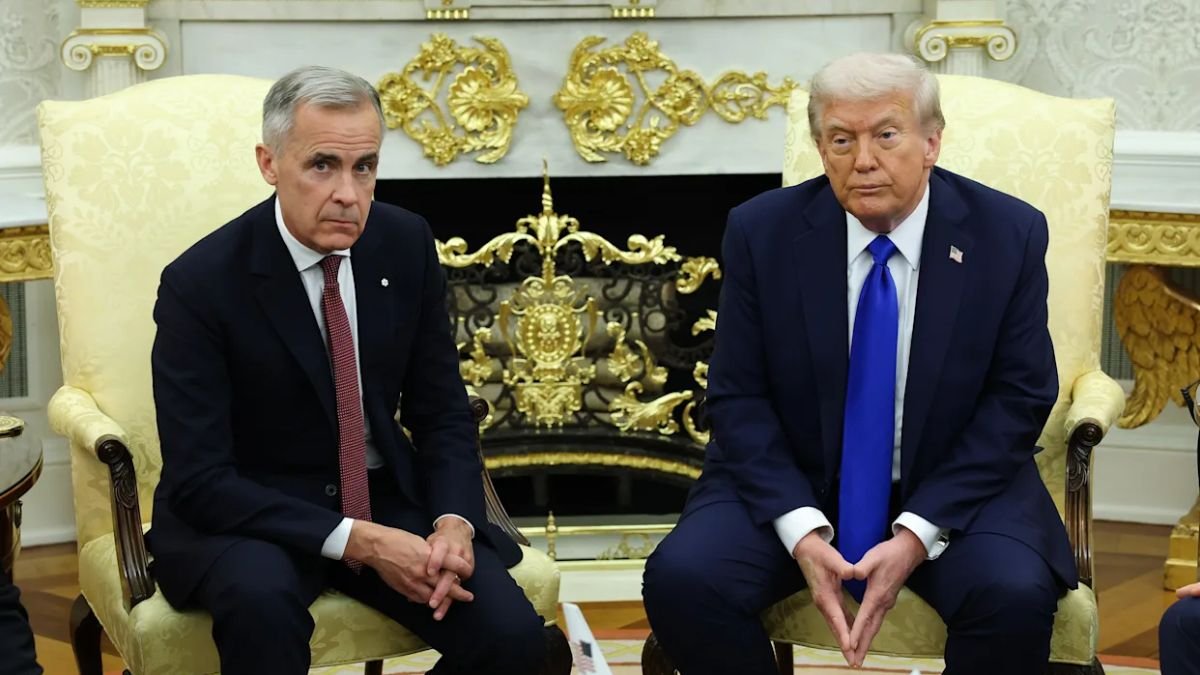
Prime Minister Mark Carney is showing that politics, at its most serious level, is not only about everyday concerns such as gas prices, housing costs and household affordability.
Those issues remain important, but Carney’s recent speeches suggest he wants Canadians to think beyond the immediate pressures of daily life. His message points toward larger questions about Canada’s future, its independence, and how the country should respond to a shifting global order.
Carney Pushes a Bigger National Conversation
Around Canada Day, Carney spoke directly to Canadians about major ideas that are often left to academics, commentators or policy experts.
He did not soften his message. Instead, he warned that Canada must change because the world around it is changing.
His argument was clear: the assumptions that shaped Canada’s foreign policy, economy and security for decades can no longer be taken for granted.
A Changing World Order
Carney’s comments reflected the idea that the old international order is giving way to something new.
For generations, Canada’s relationship with the United States was seen as one of the safest and most dependable partnerships in the world.
The two countries shared the world’s longest undefended border, deep trade connections, cultural similarities and decades of mutual trust.
However, Carney appears to believe that recent events have shown Canada can no longer rely so heavily on the U.S. as a stable and predictable partner.
Trump as a Wake-Up Call for Canada
The rise of U.S. President Donald Trump has become a major warning sign for Canadian leaders.
Trump’s conduct has shown how quickly the Canada-U.S. relationship can be damaged by one hostile president.
He has repeatedly insulted Canadian sovereignty and even told Carney directly that he would like Canada to become the 51st state.
That type of statement raises a serious question: how can Canada depend completely on a country whose leader speaks about it as if it were territory to be absorbed?
Trump’s Territorial Ambitions and Allied Tensions
Canada has not been the only country targeted by Trump’s expansionist language.
He has also spoken about annexing Greenland, even though it belongs to Denmark, a NATO ally of the United States.
His behaviour toward traditional allies has often been harsher than his approach toward adversaries.
He has criticized the United Kingdom, mocked the European Union, and blamed allies for not supporting his military actions, including his conflict with Iran.
At the same time, Trump has maintained a friendly posture toward Russian President Vladimir Putin, creating further concern among U.S. allies.
Canadian Values Versus Trump’s America
For many Canadians, Trump’s approach to power clashes sharply with Canadian values.
His war with Iran and his domestic crackdown on immigrants are described as the opposite of Canada’s political identity.
Canada’s view of force has traditionally been more cautious, treating violence as a failure of diplomacy rather than a first option.
Likewise, immigrants are often seen in Canada not as a threat, but as an essential part of building society and supporting economic growth.
Canada’s Trade Dependence on the United States
For years, Trump acted as though other countries needed the United States far more than America needed them.
When speaking about Canada, he even claimed that the country had nothing the U.S. required.
That claim ignores the scale of Canada’s importance to the American economy.
Canada sends about four million barrels of oil per day to the United States and accounts for roughly 60 per cent of U.S. oil imports.
Carney’s Push for Sovereign Energy Independence
Carney’s most important political move may be his effort to challenge the assumption that Canada is dependent on the United States and has no alternatives.
He announced a major plan involving $1 trillion in spending over several years to help Canada achieve sovereign energy independence.
The proposal has been described as the Canada Day bomb.
The plan would focus on electrifying Canada and building a new pipeline from Alberta to the West Coast.
These projects are intended to strengthen Canadian sovereignty and reject the idea that Canada is merely America’s “captive backyard.”
Building New Trade Relationships
Carney has also made it clear that Canada must work harder to find new trading partners.
This is not a small challenge.
Canada currently sends about 85 per cent of its exports to the United States.
That level of dependence makes the American market extremely important, especially for provinces such as Ontario, where cross-border trade plays a major economic role.
Replacing or reducing reliance on the U.S. market will be difficult, but Carney’s argument is that Canada has no choice but to begin.
Risks of Standing Up to Trump
Carney’s effort to reduce Canada’s dependence on the United States may be necessary, but it also carries political risks.
Trump has repeatedly shown himself to be a highly vindictive president.
While former President Richard Nixon was associated with the Watergate scandal, Trump has been accused of turning the U.S. Justice Department into a political weapon against opponents.
Figures such as James Comey, Letitia James, John Bolton, E. Jean Carroll and Jerome Powell have all been targeted by Trump in different ways.
The concern is that Carney could become another target if he continues pushing Canada away from U.S. dependence.
A “Canada Strong” Economic Vision
Despite the difficulty, Carney’s broader vision of a stronger and more independent Canada is worth pursuing.
His idea of Canada Strong is based on increasing economic activity between provinces, building new trade partnerships and investing more deeply in Canada’s own resources and industries.
For too long, Canada has exported valuable natural resources without adding enough value before sending them abroad.
Carney’s vision suggests Canada should process, develop and benefit more from its own resources before exporting them.
Canada’s Natural Advantages
Canada has many strengths that support this kind of national strategy.
The country has abundant natural resources, a skilled and educated workforce, and one of the most valuable land bases in the world.
These advantages give Canada the potential to become more economically independent, more globally competitive and less vulnerable to political instability in the United States.
A Future Built on Canadian Trust
Carney’s message ultimately points to a simple idea: Canada must trust itself more.
Instead of relying too heavily on one powerful neighbour, Canada should build stronger internal partnerships, deepen provincial economic ties and create new international opportunities.
The country’s future should be based on independence, prosperity, freedom and openness.
Mark Carney’s recent speeches show that his political vision goes beyond short-term issues such as gas prices and housing costs. He is asking Canadians to think about sovereignty, energy independence, trade diversification and the future of the country in a changing world.
The rise of Donald Trump has exposed the risks of relying too heavily on the United States, especially when American leadership can become hostile toward allies.
Carney’s plan to invest heavily in Canadian energy infrastructure, expand trade options and strengthen the country’s internal economy is ambitious and risky, but it reflects a growing belief that Canada must depend more on itself.
The central message is clear: Canada’s strongest and most reliable partners may ultimately be Canadians themselves.