
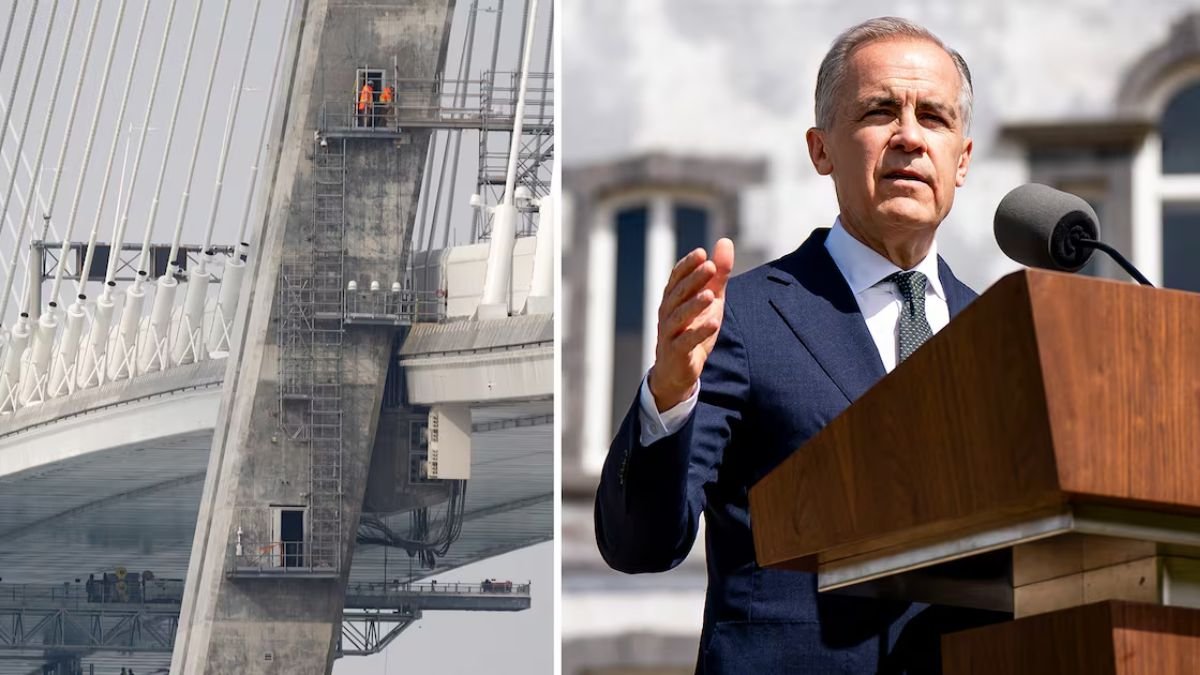
Canada’s decision to share part of the Gordie Howe International Bridge profits with the United States is facing criticism from taxpayer advocates and federal Conservatives.
However, business leaders and trade experts argue that the agreement is worth it because the new crossing is expected to strengthen one of the busiest trade routes in North America.
The bridge, connecting Windsor, Ontario, and Detroit, Michigan, is now scheduled to open on July 27, 2026, after Canada, Michigan and the U.S. reached a new agreement on toll governance and regional investment.
Canada and U.S. Reach Bridge Agreement
Housing, Infrastructure and Communities Canada announced that Canada and Michigan had agreed to open the bridge with support from the U.S. government.
The agreement includes cooperative measures around toll transparency, toll-rate adjustments and the creation of a 15-year economic development fund tied to a portion of profits from bridge operations.
The deal appears to have resolved a dispute that had delayed the bridge’s near-term opening.
U.S. to Receive Share of Toll Profits
Under the new arrangement, the United States will receive 50 per cent of net toll revenue profits, and U.S. approval will be needed for toll increases above 10 per cent, according to Reuters.
A source cited in the original report also said the agreement requires U.S. approval before tolls can be lowered below the regional average.
The federal government has described the agreement as a way to encourage both countries to increase traffic and move the bridge toward profitability.
Trump Dispute Delayed the Opening
The bridge had originally been expected to open earlier, but its planned June ribbon-cutting was postponed.
The delay followed demands from President Donald Trump, who had threatened to block the opening unless the U.S. received partial ownership or other concessions. AP reported that Trump had pushed for a U.S. stake and raised objections over the bridge’s financial arrangements.
The dispute also drew attention because the bridge will compete with the privately owned Ambassador Bridge.
Ambassador Bridge Owner Scrutiny
The competing Ambassador Bridge is owned by the Moroun family.
Reports have noted that Matthew Moroun, chairman of the company that owns the Ambassador Bridge, donated US$1 million to a pro-Trump political group before the dispute escalated.
Financial Times reported that the Moroun family had long opposed the new public bridge because it could affect Ambassador Bridge revenue.
Canada Funded the Bridge Upfront
Canada agreed in 2012 to finance the bridge project after Michigan lawmakers refused to contribute public funds.
The Canadian government expected to recover its costs through tolls collected from traffic using the crossing.
The bridge is jointly owned by the Government of Canada and the State of Michigan, while Canada funded the project upfront with repayment expected through future toll revenue.
Minister Calls Deal a Win for Both Countries
Infrastructure Minister Gregor Robertson described the agreement as beneficial for workers and businesses on both sides of the border.
He said the bridge will encourage more trade, support business activity and create incentives for both Canada and the U.S. to increase traffic through the crossing.
The federal government says the bridge will improve supply chains, support manufacturing and make the movement of essential goods more efficient.
Taxpayer Advocates Criticize the Deal
The Canadian Taxpayers Federation criticized the agreement, saying taxpayers paid for the bridge and are now seeing part of the profit shared with the U.S.
National director Franco Terrazzano said the situation is frustrating because cross-border trade is important, but taxpayers may feel they are losing part of the return on a project they funded.
Business Groups Support Opening the Bridge
Business leaders say the economic benefits of opening the bridge outweigh concerns over the profit-sharing deal.
Flavio Volpe, president of the Automotive Parts Manufacturers’ Association, said exporters on both sides of the border have been waiting for the new crossing.
He said the bridge offers major operational advantages because it is two lanes wider than the Ambassador Bridge, includes automated tolling and provides direct highway access.
Auto Sector Sees Major Benefits
Volpe said the agreement’s political details matter less to an auto industry that relies on deeply integrated Canada-U.S. production.
A single auto part can cross the border several times before becoming part of a finished vehicle.
For that reason, he said getting the bridge operational is a major win for manufacturers and suppliers.
Trucking Industry Welcomes New Crossing
The Canadian Trucking Alliance also welcomed the bridge opening.
President and CEO Stephen Laskowski said the trucking sector has long pushed for a modern second crossing at Windsor-Detroit.
He said the Gordie Howe International Bridge will strengthen the North American supply chain and support the economic partnership between Canada and the United States.
Trade Experts Say Bigger Picture Matters
Trade experts say Canada could not afford to let the completed bridge remain unused.
Fen Osler Hampson, a Carleton University professor and co-chair of the Expert Group on Canada-U.S. Relations, said the bridge had become an irritant in Canada-U.S. relations during a sensitive period for trade negotiations.
He said critics may argue Canada gave up too much, but the larger benefit is getting a vital trade asset into service.
Conservatives Demand Transparency
Federal Conservatives criticized the agreement and accused Prime Minister Mark Carney of making concessions through a piecemeal approach to Canada-U.S. trade issues.
Shuv Majumdar, the Conservative critic for Canada-U.S. relations, said the deal reflects a strategic failure and suggested the government should have pursued a broader trade agreement instead of handling issues one by one.
Majumdar also sent an open letter to Intergovernmental Affairs Minister Dominic LeBlanc, asking the government to release the full agreement and provide a cost breakdown before the bridge opens.
Michigan Governor Praises the Project
Michigan Governor Gretchen Whitmer called the bridge a symbol of the long-standing partnership between Michigan and Canada.
She said thousands of Michigan workers helped build the project and that the bridge will support auto production, reduce costs, ease traffic, strengthen agriculture and create better-paying jobs.
Bridge Expected to Boost a Major Trade Corridor
The Gordie Howe International Bridge is designed as a six-lane, cable-stayed bridge across the Detroit River.
The federal government says the bridge has an 853-metre main span, making it the longest cable-stayed span of its kind in North America, and extends about 2.5 kilometres overall.
It will also include modern ports of entry on both sides of the border with advanced border management and screening systems.
Ambassador Bridge Remains a Key Competitor
The privately owned Ambassador Bridge currently handles a major share of Canada-U.S. trade.
The corridor moves hundreds of millions of dollars in goods each day, especially for the automotive sector.
However, the Ambassador Bridge has faced criticism over high tolls, and the new Gordie Howe crossing is expected to create more competition, capacity and reliability for cross-border traffic.
The Gordie Howe International Bridge deal has triggered a political debate over whether Canada gave up too much by agreeing to share net toll profits with the United States.
Taxpayer advocates and Conservatives see the arrangement as costly, while business groups, trucking leaders and trade experts argue that opening the bridge is far more important for the regional economy.
With the crossing now expected to open on July 27, the focus shifts to whether the bridge can deliver the promised gains in trade, traffic flow and supply-chain resilience.