
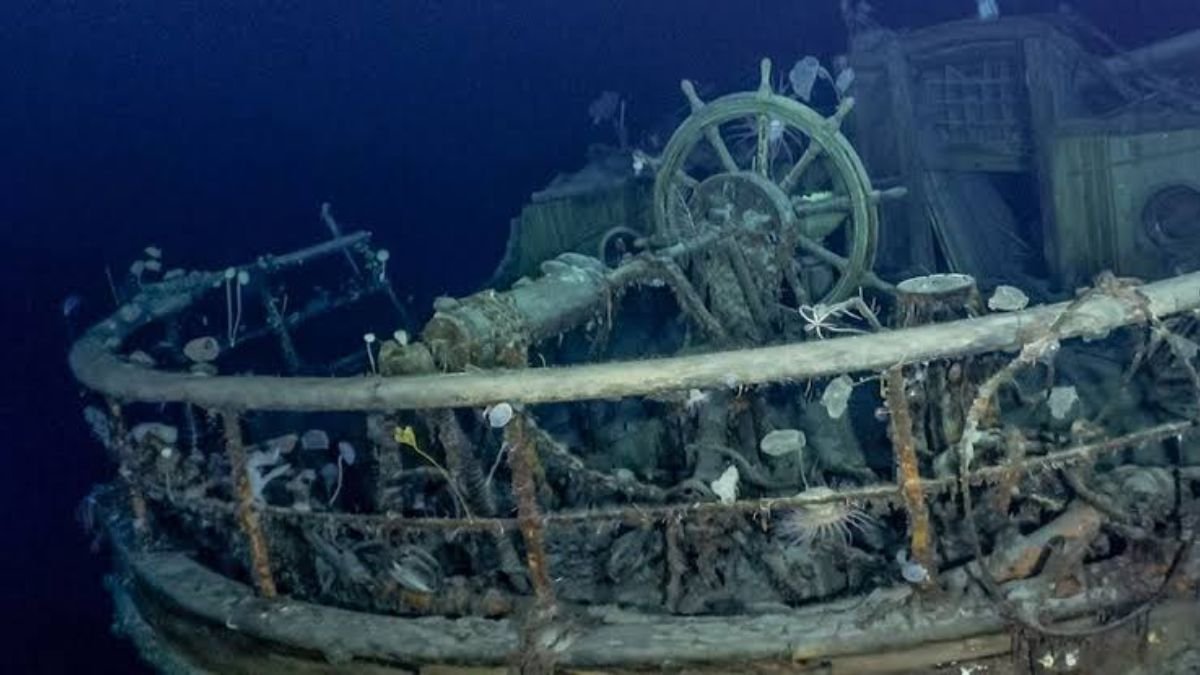
An expedition nearly 400 metres below the surface of the Labrador Sea has revealed the first images of Quest, the ship that carried legendary Antarctic explorer Sir Ernest Shackleton on his final voyage.
The Royal Canadian Geographical Society sent a remotely operated vehicle, or ROV, down to photograph the wreck where it sank off the coast of Labrador in 1962.
First Images Show Wreck Tangled in Fishing Lines
CBC News is aboard the research vessel Atlantis with exclusive access to the expedition.
The first images show the stern of Quest tangled in fishing lines.
David Mearns, co-chief scientist of the expedition and a professional shipwreck hunter who has located 29 wrecks, said the condition of the wreck was disappointing.
He said the fishing nets may have caused more damage than the wreck would have suffered if it had remained undisturbed on the ocean floor.
Quest Was First Located Two Years Ago
The wreck site was first discovered by the Royal Canadian Geographical Society two years ago using side-scan sonar.
Mearns said the original sonar data did not show signs of nets around the wreck.
However, the new images clearly show fishing gear on the ship.
He called the discovery disappointing but said the team must now work with what they have found.
Largest Expedition in RCGS History
This mission to photograph and study Quest is the largest expedition ever undertaken by the Royal Canadian Geographical Society.
The project is costing millions of dollars.
The society partnered with the Massachusetts-based Woods Hole Oceanographic Institution, using its ship and submersible technology to explore two shipwrecks in the Labrador Sea.
First Dive Made With Alvin Submersible
John Geiger, CEO of the Royal Canadian Geographical Society and head of the expedition, was inside the submersible Alvin during the first dive on the wreck.
He described seeing the bow of Quest emerge from the darkness as a powerful moment.
Geiger said the sight made him think about Shackleton and the long history of the ship.
Quest Was Shackleton’s Final Ship
Quest was originally purchased by Shackleton for a planned expedition to Northern Canada.
However, when the Canadian government did not support the mission, Shackleton instead used the ship for Antarctic exploration.
He died of a heart attack aboard Quest in January 1922 near South Georgia, a remote island about 1,400 kilometres southeast of the Falkland Islands.
Ship Later Used in War and Sealing
After Shackleton’s death, Quest continued to have a varied working life.
During the Second World War, the ship was used as a minesweeper.
Later, a Norwegian company used it for seal hunting.
In 1962, Quest sank off the southern coast of Labrador after ice crushed its hull.
All crew members survived, but the ship’s cargo of thousands of seal pelts was lost.
Researchers Confirm Wreck Is Quest
Although the ship’s name and registration number are not visible, researchers say the wreck is clearly Quest.
Research director Antoine Normandin, who calculated the original search location, said distinctive features match historic photographs of the vessel.
He pointed to two portholes below the bridge as key evidence.
Normandin said it was disappointing to see damage from trawl fishing, but he was encouraged that several historically important sections of the ship remain intact.
Wreck Lies in Closed Fishing Area
Quest rests in the Hawke Channel, an area that has been closed to fishing since 2002.
Despite that closure, fishing nets are covering much of the ship’s starboard side.
This makes it harder for researchers to capture clear images of the wreck underneath.
Part of the mission is to create a digital twin of the shipwreck using advanced 3D imaging technology.
Expedition Will Next Study Terra Nova
After several days of dives on Quest, the expedition will travel to the southern tip of Greenland to explore another historic shipwreck: Terra Nova.
Terra Nova was originally owned by the Bowring Company of St. John’s.
Explorer Robert Falcon Scott used the ship during his fatal 1912 expedition to the South Pole.
The wreck was discovered in 2024, and researchers hope the RCGS mission will reveal what parts of the ship remain, what has changed, and what the surrounding 300-metre debris field can tell them.
The first images of Shackleton’s Quest shipwreck have given researchers a powerful but troubling look at the historic vessel nearly 400 metres below the Labrador Sea.
While fishing nets appear to have damaged parts of the wreck, key sections remain intact and confirm the ship’s identity.
The expedition will now use advanced imaging to document Quest before moving on to another historic wreck, Terra Nova, near Greenland.